
Leading Tulane Law into the future
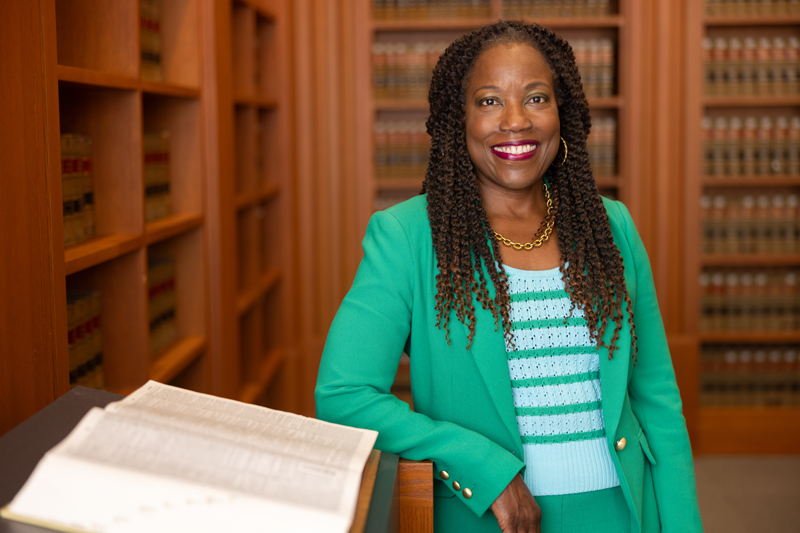
Tulane Law School Dean Marcilynn Burke had long admired the school’s strengths in environmental and natural resources law, her own area of expertise. When the opportunity to lead the school arose, Tulane’s strong reputation in energy law, maritime law, comparative and international law and public service made the role even more compelling.
“I was drawn to Tulane because of its strengths in environmental and natural resources law, which is my field,” she said. “The overall academic excellence here and the connection to the community really drew me in.” She was especially impressed by Tulane’s robust pro bono program and legal clinics, which not only equip students with real-world legal experience but also provide critical services to the community.
Her resume is impressive. Before Tulane, Burke most recently held the role of dean of law and the Dave Frohnmayer Chair in Leadership and Law at the University of Oregon. She has also been a law professor at the University of Houston, where she later served as associate dean. In addition to academia, she worked in the U.S. Department of the Interior from 2009 to 2013, serving first as deputy director for programs and policy at the Bureau of Land Management. She later was appointed by President Barack Obama as acting assistant secretary for land and minerals management. Early in her career, she practiced law, specializing in environmental law, antitrust and both civil and criminal litigation.
As Tulane Law dean, Burke has made it a priority to strengthen connections with Tulane Law alumni nationwide, recognizing that their engagement is essential to the school’s continued success.
From her first days in the role, she has been actively reaching out to alumni, with meet-and-greets in New Orleans before expanding her travels to Austin, Houston, New York, San Francisco and Washington, D.C., with more stops planned.
Recognizing that Tulane Law has not engaged in a formal strategic planning process in years, Burke has made it a priority to develop a vision for the school’s future.
“I kicked that off in an informal way with the faculty and staff when I started,” she said. “And my next stage is to go to the Dean’s Advisory Board, which is one of the primary ways in which I am substantively connected to our alumni.” Through these conversations, she is working to identify short- and long-term priorities that will position Tulane Law for continued success.
In addition to her work shaping the future of Tulane Law, Burke has been immersing herself in life in New Orleans.
She enjoyed her first Mardi Gras as a resident, and when asked about her favorite places to eat, she immediately named Chapter IV, a restaurant she frequented while living in Tulane’s Gravier Street building, Thirteen15. “I met (owner) Dook Chase IV in my first week on campus,” she said.
Although she has only been in New Orleans for about six months, one thing has already left a lasting impression: how deeply connected everyone is.
“I didn’t think of New Orleans as a small place because of its rich history and culture,” she said. “But I’ve realized it’s a close-knit community where people really care about the success of the city and Tulane Law School. There’s a deep sense of pride, care and compassion here.”