
Newcomb alumna’s memory book details Junior Year Abroad in France
Sometimes only by looking back on an experience do you truly appreciate it.
Such was the case for Marly Sweeney (NC ’74, SW *77) and many of her classmates, who have come to treasure their Junior Year Abroad in Paris ever more in the past half century.
“We didn’t really appreciate — in a way that you don’t when you’re 20 and 21 years old — how astounding the program was.”
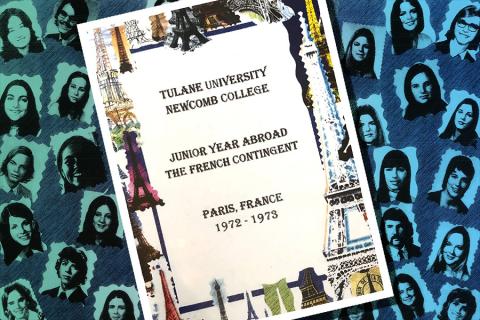
The experience was so transformative that Sweeney has created a memory book commemorating the 1972-1973 Junior Year Abroad (JYA).
The spiral-bound book, more than an inch thick and over 300 pages, celebrates every step of the trip, from the experience sailing to Europe on luxury ocean liner the SS France to classroom time at the Sorbonne in Paris.
The friendships forged in Paris have stood the test of time, said Sweeney. “I made these long-lasting friendships, and we’re all still friends. We’ve been getting together for years ever since then.”
It was during those frequent reunions that the group discussed putting together a memory book about the year. During the pandemic shutdown, Sweeney found that she finally had the time to devote to the project. What she thought would take a few months took nearly three years, but the JYA alumni are thrilled with the final product.
The book includes memories from many of the 23 participants in their own words. Every time Sweeney was working on a section of the book, she would solicit remembrances from her former classmates over email. “I would say, ‘help me, who remembers this?’”
Sadly, several JYA participants had lost many of their mementos from the time in Hurricane Katrina, so the book proved especially important.
“I lost everything I had saved from junior year abroad in Katrina because I lived in the lakefront, so it was even more touching to have some of those memories that Marly put together,” said participant Robin Giarrusso (NC ’74, L *77).
The book describes that the students’ first stop in France was Dijon where the two French professors in charge of the group met with the students daily. “They started our culture lessons right away,” Sweeney said. “We’re sitting at our first dinner, and they said, ‘alright, everybody, arms on the table. No hands in your laps like the Americans. We don’t do that.’”
Next, the women stayed for a couple of weeks at a convent in Dijon — the Foyer des Soeurs de Cluny — while the men stayed at a nearby university. Sweeney said she will never forget the experience of staying in a room on the top floor of the convent, which dated to the 16th or 17th century. The room looked out onto the rooftops of Dijon.

Standing left to right: Margo Bretz Toledano, Jan Postove Ortego, Phil Masquelette, Amy Gardner, John Fitzgerald
2nd row seated: Jane Dabdoub Bartlett, Herb Larson, Marly Sweeney
Seated on floor: Mary Ann Day, Julie Schwam Harris
“We would all meet in my room, and we would sneak a bottle of wine and chocolate and we would just sit and talk all night long. It was absolutely marvelous.”
The American students’ time in Dijon even made the local newspaper, and Sweeney included the articles in her book.
After a weeklong cultural tour of the Loire Valley, where the students visited palaces, chateaux and cathedrals, they stayed with families in Dijon for three weeks. The memories diverged on that time, with some students being treated like a member of the family and others feeling like Cinderella (before she met the prince).
“We would all meet in my room, and we would sneak a bottle of wine and chocolate and we would just sit and talk all night long. It was absolutely marvelous.”
Shortly after the homestays, the students left for the Sorbonne in Paris. Sweeney remembers they would learn about a work of art, then walk to the museum to see it firsthand. “We went to stand in front of all the paintings we were studying.” She also describes the experience in a dimly lit French classroom, with “hundreds of students in a round theater with the professor at the bottom in the middle. And there was only one light bulb suspended on a wire (tres francais, n’est ce pas?)”
Luckily for their grades, Tulane was part of a consortium at Reid Hall, so the Tulane students were afforded tutors that helped them learn the material in small groups.
In the book, the participants remember the many live theater experiences, long strolls across Paris, French cuisine, distinctive French professors and traveling throughout Europe during school breaks. For many, the Junior Year Abroad changed their lives, fostering a lifelong love of travel. But the most meaningful for most were the friendships they made during that year, friendships that still survive today. For as they say in France, “L’amitié, comme le vin, se bonifie avec le temps.” Friendship, like wine, gets better with time.
