
Q&A with Navy Commander Katie (Hagen) Jacobson (B ’04)
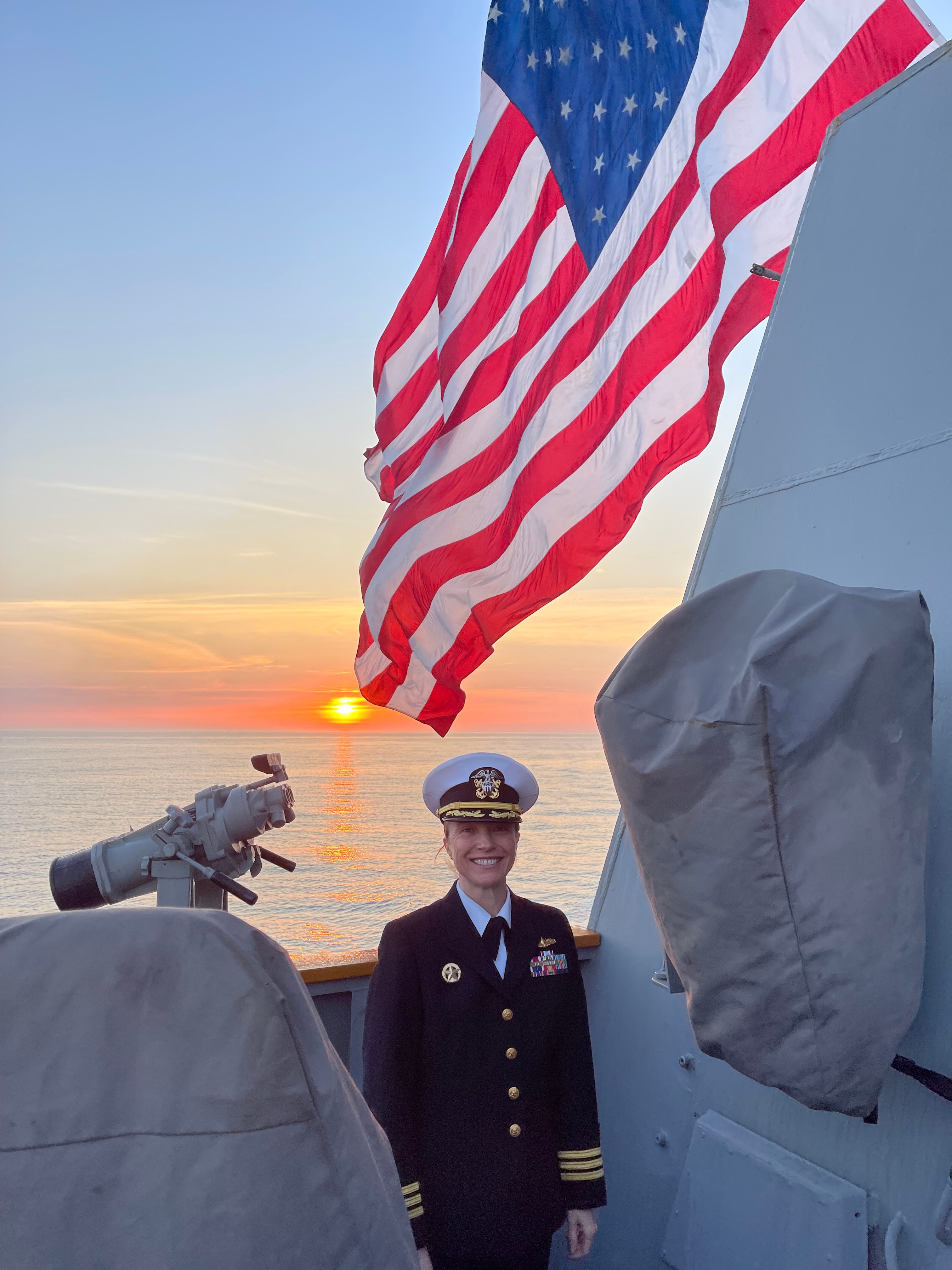
Commander Katie (Hagen) Jacobson embarked on her naval journey in 2004, following her graduation from Tulane University's Navy Reserve Officer Training Corps (NROTC) program. At Tulane, she studied finance at the A. B. Freeman School of Business.
Jacobson’s distinguished naval career includes five deployments and numerous accolades, notably the Defense Meritorious Service Medal. Currently, Jacobson is commanding officer of USS NITZE (DDG 94), overseeing the ship’s renovations in Norfolk, Virginia.
Jacobson assumed command of the guided-missile destroyer in September 2022 during a nine-month deployment focused on fortifying maritime security and stability in the Middle East. During this deployment, the ship not only visited various international ports and hosted U.S. ambassadors to Turkey and Malta but also played a pivotal role in the confiscation of illicit narcotics worth millions of dollars.
"Maintaining the safety of a warship really does require 24/7 365 effort, and it’s no small task."
Navy Commander Katie (Hagen) Jacobson (B ’04)
In the following Q & A, Jacobson shares insights into her role as a ship commander and reflects on her transformative years at Tulane.
Q: You were in the (Reserve Officers’ Training Corps) ROTC at Tulane. Can you tell me about that?
A: I had a wonderful experience as an ROTC Midshipman because not only did I have a built-in network of teammates to help me prepare for my upcoming military career, which honestly, I had no insights into prior to joining ROTC. But I also had the typical college experience of a Tulane undergrad. So, I got a taste of what the military was like, and I was a normal college student, I really had the best of both worlds.
Q: What has been your trajectory between your Tulane graduation to becoming a commanding officer?
A: Other than my grandfather, who served in the Coast Guard for four years, I really had no family history of military service. My inspiration to join really came based on my experiences in Sea Scouting, which is a program of the Boy Scouts of America for young women and men ages 14 to 20. My Slidell neighbor at the time, a retired Coast Guard commander, recommended I look into military service as an option to pay for college. Tulane was always on my top list of college choices and the ROTC scholarship was very attractive, so I gave it a shot.
And here I am 19 years later, after eight cross-country moves, five deployments spanning the globe, four promotions, a marriage and two kids.

Q: Could you share a particularly memorable experience during the nine months you were deployed on the USS NITZE?
A: There was one particular day that really stands out in my mind, and this took place just inside of a month after I took command, so I was relatively new in that position. We were operating in the Gulf of Aden, approximately 50 miles off the coast of Yemen, when there was a small boat that was suspected of carrying illicit cargo. As we began to close the vessel, a fire erupted on that small boat, and within seconds, all three mariners on board jumped into the water. I saw this with my own eyes, and it was kind of a traumatic moment.
My first thought was, ‘we need to save these people. We need to get them out of the water.’ We immediately launched our small boats, pulled up alongside them and pulled the three mariners out of the water. One gentleman was in pretty critical condition, but my medical team was able to stabilize him and treat his burns. Then our attention immediately shifted to putting out the fire on the engulfed boat, which we did, but the vessel eventually sank. Later that same day, we returned all three Yemeni nationals to the Yemen Coast Guard, and I was super proud of my team for their impressive response. It certainly was a memorable day.
Q: What was a snapshot of a typical day for you when you were deployed?
A: Believe it or not, there really was no such thing as a typical day. It’s kind of hard to fathom that. But I did spend a lot of my time on the bridge, or what’s also known as the pilot house. There I can see out the windows and see other ships operating. But I would spend time up there mentoring the officers who are actually driving the ship.
And I also spent a lot of time in the combat information center, which is the central hub of our combat and sensor capabilities. Most days would consist of planning or executing a special evolution or operation. Examples of that might be preparing to do an underway replenishment, otherwise known as an UNREP, that entails going alongside an oiler for gas or supplies. Or perhaps we would be conducting a small-boat boarding of a vessel suspected of carrying illicit cargo — there’s a lot of planning that goes into that. And perhaps we would conduct a training exercise with our regional allies and partners.
So again, no real typical day. It was always very dynamic, which I appreciate and I enjoy. No two days were ever the same. But my favorite part of every day, hands down, was always walking around the ship and interacting with sailors.
Q: Why was that your favorite?
A: Sailors are super resilient and innovative and creative. I love learning who they are, what motivates them, understanding what makes them tick. Just getting to know our nation’s finest young men and women. It really is a privilege to know them and to lead them, and it always puts a smile on my face.
Q: Do you have a typical day now that you’re back in home port?
A: My days now are much more predictable. My ship is currently receiving a midlife upgrade and a 21-month maintenance availability, which means that the ship has turned into basically an industrial environment. My daily rhythm is much different than it was on deployment.
A typical day for me involves getting on the ship a little before 7 a.m. I take various briefs on the maintenance progress and the upcoming work. I am actively involved in training my crew to maintain their tactical and technical proficiency and lots of walking around the ship. I think a ship’s force presence is critical during any maintenance availability.
I’m typically home by somewhere between five and six p.m. But my officers and crew stay on duty every four days, meaning that they stay with the ship and don’t go home once every four days in order to stand watch or be available to respond to any casualty that may happen such as fire or flooding or an active shooter event. Maintaining the safety of a warship really does require 24/7 365 effort, and it’s no small task.
Q: What is the most rewarding aspect of commanding a ship?
A: Hands down, it’s leading sailors and being in a position to positively influence their lives in a meaningful way. I do that through mentorship, by removing barriers and by being an advocate.
Q: What do you think would most surprise people about commanding a ship?

A: Two things come to mind. So the first, and it’s kind of boring, but it’s a lot of administrative work. The second thing is that it took me a while to get used to the fact that anytime I’m walking around the ship, my crew announces, “attention on deck.” It’s a military courtesy where sailors stand at attention. They allow me to walk past unimpeded or until I give the command, ‘carry on.’ So, in other words I can never get from point A to point B without people knowing exactly where I am.
Q: You’re the mother of two young children. How do you balance the demands of being a commanding officer with personal and family life?
A: I'll be honest, work life balance on sea duty and particularly in this position is very challenging. And I really could not do what I do without the support of my amazing husband and mother-in-law. Part of that balance requires me to manage my family’s expectations and be as transparent as I can about when I’ll be available and when I’ll be home. My kids are young enough that the concept of time isn’t crystal clear. But when I am home, we definitely make the most of being together and we like to experience new things to build upon core memories. Because time is just that precious.
"My sailors are like family to me, and with over 300-plus sailors to care for there’s a lot of opportunity to make a positive difference in their lives.”
Q: How did your time at Tulane prepare you for a career in the Navy or for your career as a commanding officer?
A: Tulane taught me how to think critically and it taught me about the importance of teamwork and community, and that learning can and should be fun. Those takeaways really served me well in being able to think through dynamic problems and making hard decisions in the military. I found that working towards an optimal solution is a combination of level of knowledge, soliciting my team for forcible backup and gut instinct. But having fun with the overall experience is super important too, especially in maintaining an all-volunteer force.
Q: Were there any courses or professors or experiences at Tulane that had a particularly strong influence on your naval career?
A: I was in ROTC class for 9/11. I was in my uniform on campus, and my instructor at Tulane came in and told us what happened at the World Trade Center. And that day obviously changed the trajectory not just for our military effort for the next two decades, but for our world. And so that had a particularly profound impact.
Q: Where do you see your naval career taking you in the next five to 10 years?
A: I’ve always taken my career one step at a time and evaluated the factors in my life before making a decision about what’s next. My husband and kids now also get a vote. But for my next assignment, I anticipate taking command of a shore-based unit that's responsible for the early training of Norfolk, Virginia-based warships who are preparing for deployment. So I’ve got my next step mapped out, but after that remains to be seen.
Q: Are there any questions that I didn’t ask or anything else that you wanted to add?
A: I really just want to thank the Tulane University community for their relentless pursuit of academic excellence and a deep sense of pride for their community. I’ve always been very impressed with those two attributes. And I would also like to thank all of our military families past and present, who’ve sacrificed just as much if not more, as their service members, and I’m eternally grateful to them for their support.