
Rhythm and resilience: Spanier to retire after leading TUMB resurgence
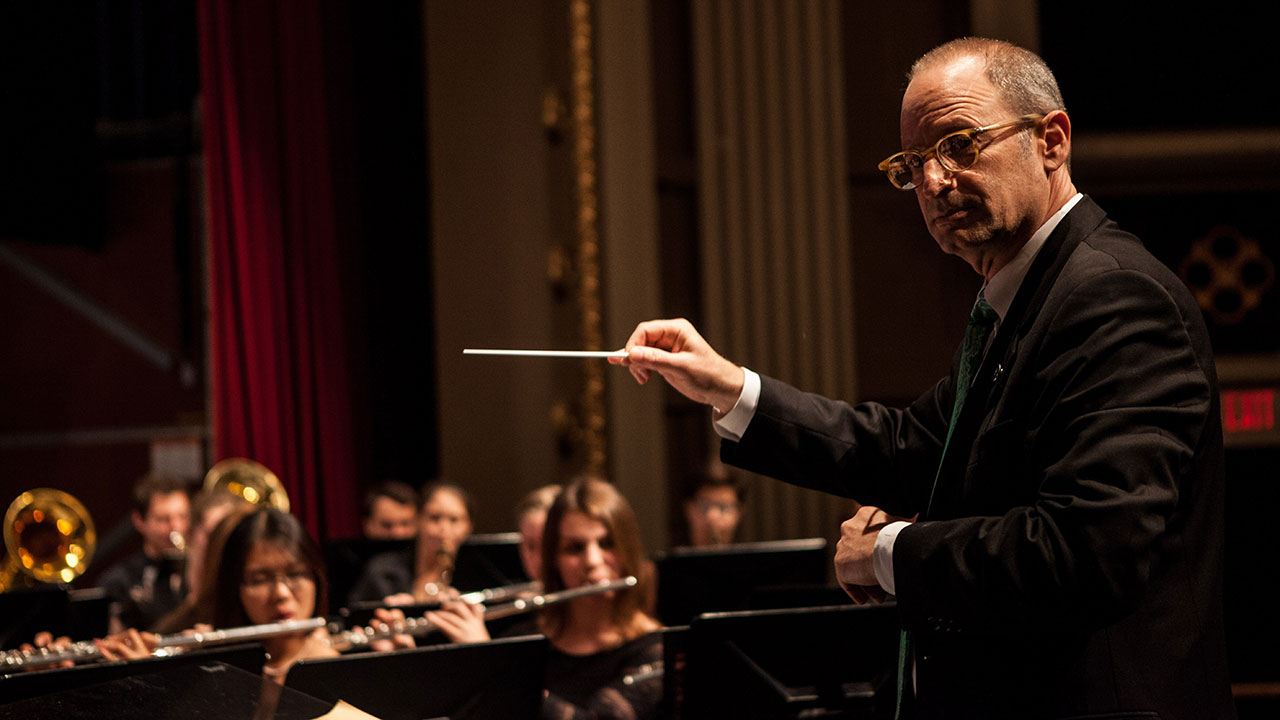
After more than two decades leading the Tulane University Marching Band, Barry Spanier will retire at the end of 2025 — closing a remarkable career that has taken him from Olympic ceremonies to royal performances to the streets of New Orleans.
His impact upon the Tulane community has been profound. The Tulane Alumni Association honored Spanier for his remarkable vision and dedication to Tulane by welcoming him to the alumni community during Wave Weekend 2025, making him an honorary alumnus of the university.
Before he came to Tulane, Barry Spanier had led bands for Olympic ceremonies. He’d led performances before the queen of England. But he had never started a university marching band program from the ground up and was excited to take on the challenge. Just as Spanier was hitting his stride, Hurricane Katrina hit.
It was the students and the alumni that got it started. They are the two bookends that make it all possible.
Barry Spanier, director of bands
Spanier had a track record of success when he arrived at Tulane. In 1984 he’d coordinated all venue bands for the Los Angeles Olympics. At the Sydney 2000 Olympics, he directed what remains the largest marching band in history — 2,000 musicians from 23 nations performing for the opening ceremonies. As director of bands at World Expo ’88 in Brisbane, Australia, he developed a full-scale marching band program that performed for Queen Elizabeth II on opening day. Plus, he’d served as associate director of the University of Southern California Trojan Marching Band and created orchestras and bands at New York University.
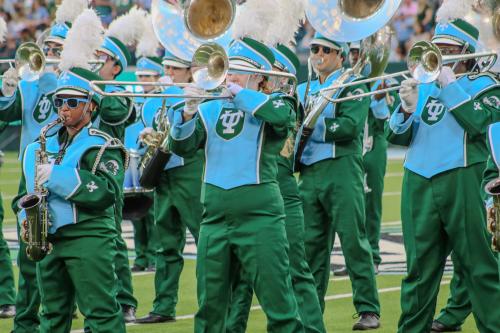
There was no doubt Spanier was a rare talent. And Tulane certainly needed one to restart the Tulane University Marching Band, which had dissolved after the closure of Tulane Stadium in the late 1970s.
Students had begun a pep band, SoundWave, in the early 1990s. Alumni, recalling how much the band had meant to them, helped to provide funds for secondhand instruments. And the administration took notice.
“It was the students and the alumni that got it started. They are the two bookends that make it all possible,” says Spanier. “I happened to fill the position.”
When Spanier arrived in 2004, Tulane offered a community of committed student-musicians, grassroots support from alumni and a home city with an undeniably musical culture. Still, he had a tall order on his hands — creating a marching band program that was a match for the university’s prestige, the city’s rich musical culture and the high expectations of proud alumni.
The revitalized Tulane University Marching Band (TUMB) was poised to hit the ground running in August 2005. Band camp was underway. New uniforms were ordered. Excitement was in the air.
But it wasn’t the only thing in the air. Churning in the Atlantic was the storm that would change the face of Tulane and New Orleans forever: Hurricane Katrina.
Maybe it’s because he so swiftly fell in love with New Orleans. Maybe being around world-class athletes at the Olympics makes insurmountable odds seem less so. Maybe he was just exactly the right man for the job. But Spanier was undaunted.
“Music is what I could do,” says Spanier.
A Tulane pep band played for the university’s first “home” game at Rice that fall. TUMB’s next act: Mardi Gras 2006.
“I’ve found that, especially at important times, music amplifies and funnels and channels emotion. And it helps give everybody agency to express it in unified ways.
“Even though everybody has a different relationship to the person or the event, it's still shared celebration or shared mourning. That is community building at its most fundamental.”
Spanier recalls TUMB’s first outing on the West Bank as cold, windy and gray with only a quarter of the city’s population having returned. “There were long stretches where there was nobody there.”
But still Spanier’s newly revitalized TUMB wended through the city. “It was very emotional. It was certainly celebratory, but in a different way. People were saying, ‘Thank you so much for marching.’”
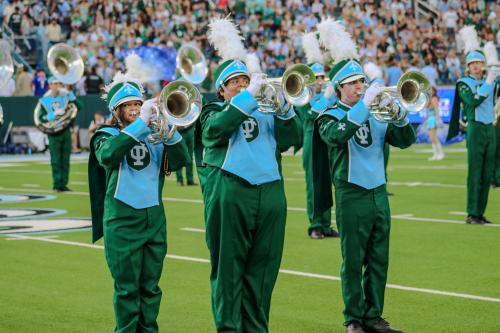
By 2014 TUMB was steadily finding its own rhythm. And it was about to ascend to the next level with the opening of Yulman Stadium. band
According to Spanier, the relationship between TUMB and the Green Wave is a reciprocal one, and he notes that engaging and pumping up the audience can be worth up to three points on the field. “The ability to keep the audience engaged and active is part of the home-field advantage. The better the band, the more pride.”
He has certainly built something to be proud of. In his 21-year tenure, Spanier has created an outstanding program. TUMB has performed at the 2020 Dubai World Expo and made television appearances on American Idol, Wheel of Fortune, Fox & Friends, MTV and NCIS: New Orleans.
For all his leadership, Spanier is firm in his belief that TUMB’s achievements come down to students. “It’s all about students first. That’s what really drives it all, the student experience.
“The students and the alumni are the key elements. Without those two groups being really engaged and enthusiastic and actively supporting it, whether as volunteers or as donors or coming back for the alumni band.”
Spanier points to New Orleans’ rich and uniquely musical culture as a strength for TUMB, noting that the city’s musical traditions are not simply about reading notes but about developing a sense of style as well.
“Students come from all over the country to go to school at Tulane, and a big draw is New Orleans. I always wanted the band program and the students in it to really be an active, authentic part of New Orleans culture. … We want them to feel like real New Orleanians after they’ve finished their time at Tulane.”
