
Meet Hridesh Rajan, Tulane’s New Dean of the School of Science and Engineering
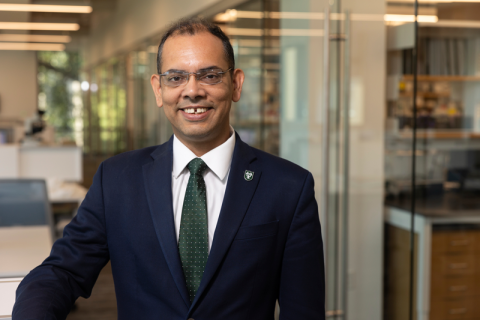
Hridesh Rajan, the new dean of Tulane University’s School of Science and Engineering, was attracted to Tulane for its leadership in fields that will shape the future.
With a deep commitment to interdisciplinary collaboration and increasing access to education, Rajan is poised to lead Tulane into a future defined by innovation and impact.
“We do have all the ingredients in the school — the energy, the talent — to make significant progress on these wicked problems.”
Rajan came to Tulane from Iowa State University, where he was Kingland professor and chair of the Department of Computer Science. There, he led the development of cutting-edge new degree programs in artificial intelligence and computer science.
He emphasized his appreciation for Tulane’s commitment to interdisciplinary work, which he views as essential for tackling the world’s most significant challenges. “It’s about not thinking in terms of silos, but in terms of how folks can communicate across boundaries.”
Rajan grew up in rural India and went on to earn both a PhD and an MS in computer science from the University of Virginia, following his Bachelor of Technology degree in computer science and engineering from the Indian Institute of Technology.
His commitment to expanding educational access for students from all backgrounds is deeply personal. “I grew up in a rural farming family,” Rajan shared. “I was able to do what I am able to do because of access to education. That transformation that education brings about and the opportunities that it opens, I’ve personally lived it.”
Rajan is not only focused on expanding access to education for students but also on leveraging Tulane’s science and engineering talent to support the broader community and the Gulf region.
“Our ReCoast project is showing that sand made from recycled glass can help prevent coastal land loss, our biomedical engineering students are creating mobility trainers for children with cerebral palsy, our psychologists are studying how estrogen use can improve memory, our chemists are inventing techniques for clean hydrogen fuel production, our civil engineers are studying impact of sea-level rise on military installations,” Rajan noted. Another prime example of this effort, he said, is the work being done by the Center for Community-Engaged Artificial Intelligence and the Jurist Center on Artificial Intelligence. Both centers collaborate with nonprofits, community members and the City of New Orleans to study and develop AI systems that are fair, transparent and beneficial to the community.
Rajan has a comprehensive vision for the future of the School of Science and Engineering, encompassing both short-term and long-term goals. In the long run, he aims to cultivate more thought leaders in the critical fields of health, energy, climate and AI. As he put it, “How can we produce more thought leaders that not only do the work but lead the way?”
In the immediate future, Rajan is focused on four key challenges that he feels that Tulane’s School of Science and Engineering is uniquely positioned to address:
- How can we engineer resilient habitats? Living in a climate-affected community, how do we not only address climate challenges but also prepare ourselves to thrive in changing environments?
- How can we prepare for the space-faring society that will emerge in the next two decades?
- How can we advance the detection of diseases, making it faster and more precise?
- How do we ready ourselves for the upcoming cognitive-cyber-physical continuum, where our brains, computers and machines will work together as one?
Those are monumental challenges, but not insurmountable — especially with the support of Tulane alumni, Rajan said. He emphasized that advancing the school’s mission requires substantial financial investment, specifically for building the core facilities needed for groundbreaking research.
“Help us create facilities that can support the research that’s going to drive the next two decades,” Rajan urged. He encouraged alumni to get involved, whether through financial contributions, volunteering or sharing their expertise by delivering lectures or mentoring students. He also highlighted the importance of alumni serving on advisory boards, helping to recruit top talent and connecting the school with opportunities that align with its strengths.
Rajan was drawn to Tulane in part because of the vibrant city of New Orleans. And since starting on July 1, Rajan and his family have quickly fallen even more in love with the city. “This is one of the world’s best cities,” he said. “If you love food, art and music, this is the place to be. We’ve enjoyed so much of what the city has to offer, and we’re looking forward to experiencing even more. So far, I’ve yet to have a food that has disappointed me.”
